Showing posts with label preparedness. Show all posts

Wednesday, October 24, 2012

Apple Core Vinegar

Everything must be saved, nothing wasted of all the summer's bounty.  Even the apple cores were saved for making vinegar...FARMER BOY (Laura Ingalls Wilder)
My first attempt at apple core vinegar.

The apple core recipe I used is found in the Little House Cookbook (Frontier Foods from Laura Ingalls Wilder's Classic Stories) By Barbara M. Walker as seen below.


This last Saturday my husband and our girls went apple picking on the Hood River Fruit Loop.  We went to the Draper Girls farm to pick apples, then went on to Mt. View Orchards Inc. & Fruit Stand .  We decided after the fact that we liked the Mt. View Orchards much better than the Draper Girls, but Draper Girls was a "pick your own" farm whereas Mt View Orchards is not.  Mt. View Orchards had better prices, organic produce, sampling was allowed, dogs on leashes were allowed, very helpful and friendly staff/family, plus they just had a better setup; more intuitive flow of their fruit stand/payment area, and charged by weight rather than arbitrarily eye balling the produce like they did at Draper Girls.

Draper girls did not have good parking, did not have organic produce, did not allow dogs, did not allow sampling, did not charge "U pick" produce by weight but by eyeballing it, did not have a good flow for getting your designated buckets to pick with, and paying for what you'd picked, were somewhat under staffed, were not all that friendly, lower parts of trees were over picked while top fruit were getting over ripe--but they wouldn't allow us to use a ladder due to liability--or so they said.  I had seen a sign that said something about asking for a ladder and signing a waiver, so I sent my 19 year old daughter and her 20 year old boyfriend back to get one.  But whoever they asked said "We don't allow the use of ladders anymore because too many kids get hurt on them".  Whatever.  So my younger daughter and I ended up sitting on our significant other's shoulders to be able to reach the ripe apples.  I told the kids we should sue them for giving their dad a back injury--just kidding. 

The worst part of the whole deal after picking all those apples was that while washing them, I discovered they had a very waxy, somewhat oily feel to their skins that did not come off with plain water, and I'm assuming its a pesticide they used.  I tried soaking them in vinegar and water, but the only way to get the gunk off was to actually wash each one with a dishcloth and dishwashing liquid.  I don't think we'll be visiting the Draper Girl's farm next year. 


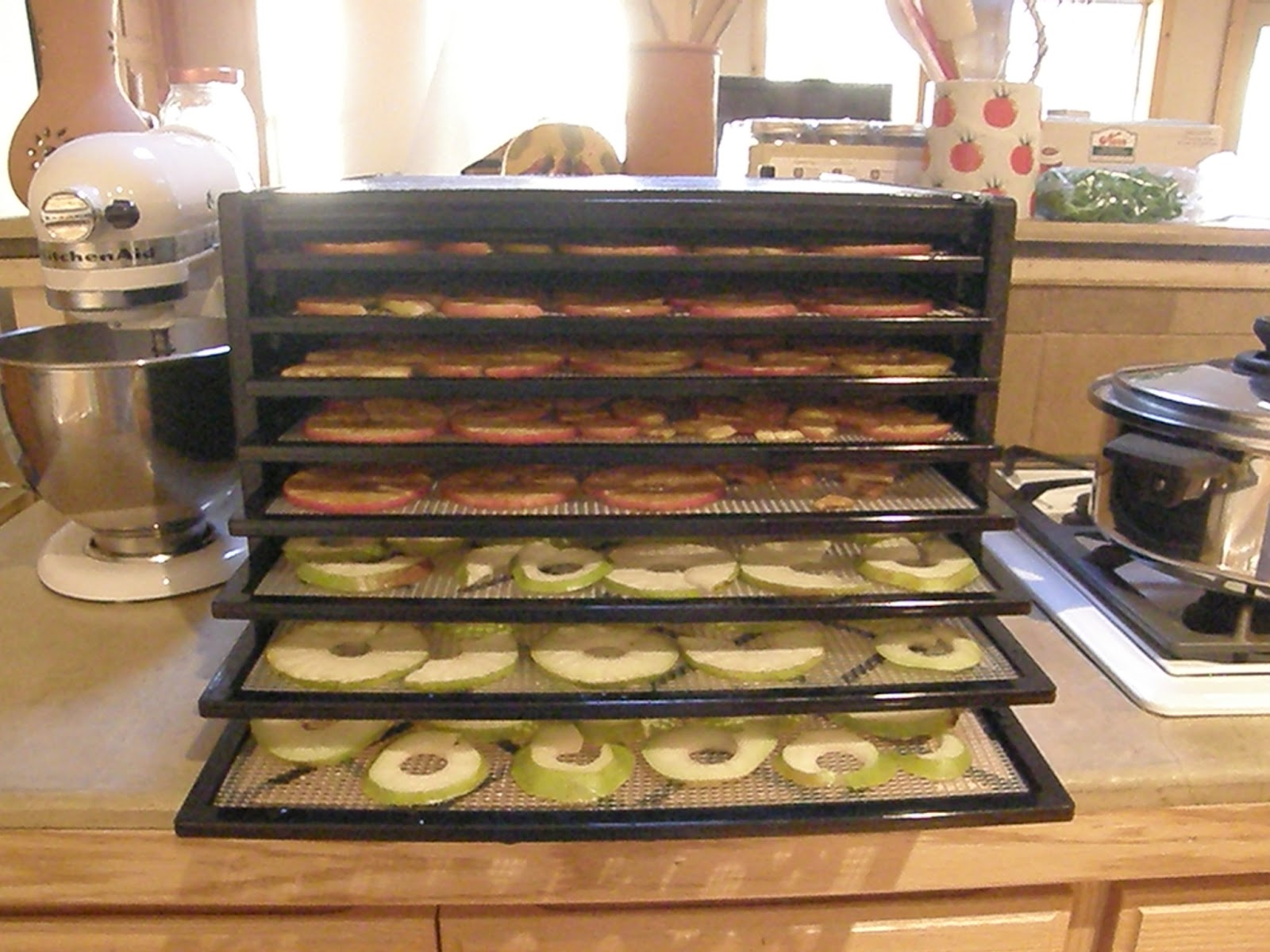
Excalibur 9 tray dehydrator
Instead, I'll be able to go over to my older daughter's mini-orchard and pick for free, which is what I should have done to begin with, but because I was working a temp job, the particular type of apples she had were past their prime before I had the time and energy to deal with them.   

So far I've canned 21 jars of apple butter, and dehydrated about 25 servings of apple and pear chips.  This week my older daughter and I will finish up by making and canning apple pie filling.  We were going to make some apple sauce, and still may, but think I think my daughter is more excited about the apple pie filling so we'll do that first and if there are any apples left over we'll make apple sauce. 

 
Update:  We made 9 quarts of apple pie filling:
 

Time For Preparedness

It's that time of year again.  Time for me to make sure I have everything  in place and ready in case we get snowed in for a few days, the electricity goes out for 2-3 days, The stream overflows it banks across the road, a wind, snow, or ice storm takes down trees across the road so we can't get out until they are cut through, or worse--a branch or tree takes down a power line across the road. All of these things have happened in the 7 years we've lived out here, 10 miles from town; some of them more than once and some years, two or three of these things happened in the same year.  For some reason, there is a conception that our area of WA state doesn't get any dangerous weather.  Some of the more notable Pacific Northwest events debunking that myth can be found at: http://www.climate.washington.edu/stormking/ .

Our deck, 12/26/08
Here in the foothills of Washington state's south-west Cascade Range temperate forest, we live in a "marine controlled environment" which basically means that our weather is mainly controlled by whatever weather is coming in off of the ocean. Usually, that means lots of precipitation, and mildish temperatures. The coldest I have ever seen it here is 19 degrees. But don't let that fool you, as you can see from the picture at left.  Anyone who's been here knows that the PNW is capable of precipitating 24/7 for days (weeks) on end. 

The picture to the left was during Christmas Break in 2008.  The only thing getting out of here was my Ford Expedition with all four tires cabled and my husband driving. He's very kinesthetically gifted, (its a beautiful thing to see him pull a wheelie on crotch-rocket and ride it for two blocks) but he did learn a thing or two about driving in the snow in Colorado to check oil wells daily for my Dad. The wells were usually located in the middle of a farmer's field with a poor excuse for an easement road.

But I digress.  Most of the people who live out here were stranded at home for almost a week during the 2008 snow event, and the people up above us were stranded for longer. They were asking if our neighbor could use his little Bobcat type tractor to plow the road (which is a actually a private drive) but his tractor couldn't make it down his driveway. 

We don't usually have nice fluffy, powdery snow here, its usually heavy and wet.  As a matter of fact I've heard it referred to by skiers as "Cascade Concrete".  It makes navigating the hills, corners, giant ditches and drop offs a bit more challenging than driving a straight line in powder conditions.  It also makes power outages due to power line poles being hit common in winter.  In "The Valley" (Vancouver town area) snow is a rare event so most people just stay home for a few days if it should happen to snow.  Up here in the hills is another story.  We usually get several good 6"+ snow events per year, and getting over a foot of snow is not unusual.

As exciting as the snow is, for the majority of the winter it is just warm enough to rain.  As a matter of fact, one of the worst scenarios I can think of (besides Fukushima completely melting down with the wind blowing this way) is a major earthquake during the rainy season.  There are several fault lines in the area. If we get a decent sized earthquake in winter when the ground is saturated, there will probably be multiple mud slides, many trees toppled plus structural damage to buildings.  There are usually a couple mudslides across major highways here every winter without earthquakes, so I can only imagine if there were one!   It could be a while before we could get to town, even if the earthquake itself wasn't that bad.  I'm going to assume that at least part of our house would still be standing should anything happen because Mr. F does everything to the extreme, so it's very well built.   

So, what are the biggies that we need every day if we can't get out? 
  • Food
  • Water
  • Shelter
  • First aid
  • Heat or Fire
  • Light
  • Tools and
  • Information (to build and fix things--hard copy books).  
  • Medical Prescriptions 
  • A few creature comforts are never amiss, I have shelves and shelves of books. 
  • Communication/Information (Ham radio? We have very little to no cell phone service here.)
Just because I happened to notice my kerosene lamps the other day, and because we have most of the other stuff taken care of, I'm going to start with "light".

If there is no electricity (which is likely because most of the power lines out here are above ground) we have a generator that can be direct connected into our electrical box thingy in the basement, so we'll have electricity that way, but we don't want to run the generator all the time, especially not at night. 

Here at latitude 45.6, on December 21, the shortest day of the year for 2012, we will have 8 hours, 42 minutes and 06 seconds of daylight.  That leaves us with about 15 hours of darkness. Add to that the fact that it is likely to be overcast and raining/snowing which seems to extend the darkness hours.  What are our options for light?

I have three cheap kerosene lamps, a few packs of emergency candles, and a large package of tea lights, an olive oil lamp (cheap and easy to make) and the random flashlight with a few extra batteries. 

Care and Keeping of Kerosene Lamps

Out of my assortment, the kerosene lamps put out the most light but also require the most care. Mr. F does have at least one propane lantern, but I don't have enough knowledge about it to say anything, so I'm leaving that alone for the moment. Right now I need to purchase some more lamp oil or kerosene (lamp oil burns cleaner) and wicks even though I didn't use up all I had for the last couple years.  The reason for this is that lamp oil and/or kerosene are only good to burn for light for about 2 years maximum.  After they have deteriorated, neither will soak through the wicks right, nor will they create much of a flame, but they will smoke--a lot. Just like leaving gas in your motorcycle over the winter and not doing all the winter prep leaves various parts gummed up. 

Clean out your lamp's fuel reservoir about once a year, with mild soap (dish soap) and water, rinse well and allow to dry completely before adding fuel. A lamp's fuel reservoir must be washed if/when switching back and forth between lamp oil and kerosene--the two should not be mixed.  After adding fresh fuel, submerge and soak a new wick in the fuel for at least one hour before attempting to use--the wick needs to be completely saturated with the fuel in order to burn correctly.  A longer soak will not hurt it.    After soaking, run the wick through the lamp's burner as usual.  I like to do this step every autumn, because I don't want to have to wait for an hour or more for a good light. 

I'm thinking about buying new burners for my lamps because a quality burner will make a difference in how much light a lamp can emit without smoking.  Parts for kerosene lamps and the olive oil lamp (below center) can be found at Lehmans (no association).

Safe Candle Holders

To make a quick and safe candle holder, fill a canning jar half way with dry beans, rice, lentils, peas, pebbles, marbles, fish tank gravel, sand, (or even dirt if you're in a real pinch) and stick an emergency candle in the center.  Make sure you use a canning jar because they have been tempered to handle the heat.  Don't use saved pickle jars, spaghetti sauce jars, etc. as they are more likely to break.  A tea light can be simply set in the bottom of a half pint canning jar and lit, or it can be bolstered by anything you can use to stand an emergency candle up in a jar. 

Used food grade metal cans are another cheap and quick candle holder, but be careful when touching because metal is an excellent heat conducter, whereas glass is a poor heat conductor (some call it an insulator).  Metal cans make better emergency heaters than lamps, but can double for both as long as caution is used. 

We'll explore homemade stoves in a future post.  What are your favorite alternative light sources? 


Tuesday, October 9, 2012

Luba Wold, Russian Immigrant Tells It Like It Is.

http://www.flickr.com/photos/28495615@N02/4601696264/
Luba Wold is a Russian immigrant who came to the U.S. 20 years ago.  While in Russia, she lived in a small Siberian village.  In this article, she tells of her experience growing up in Communist Russia, and how she feels that the U.S., if it keeps heading in the direction it is going, will end up to be much like Russia was.  Her story highlights the struggles and poverty of the Russian people and explains the reason the Russian people never fought for their freedom. 

I wish they still taught about the reality of living under a Socialist or Communist regime in public school, but according to what I've seen lately, its more the flip side that they are teaching--Social Justice.  Well, this is what your so called "Social Justice" really looks like. 

http://www.cdapress.com/columns/my_turn/article_7f73c492-83cc-5d62-a0ce-0c6969721cd4.html

Free Ebook: The Free Rangers A Story of the Early Days Along the Mississippi [Kindle Edition]

I'm into this one a few pages.. the writing is very descriptive; lots of good word pictures.  I'm thinking its going to be a very nice historical, mountain man type novel. 

The Free Rangers A Story of the Early Days Along the Mississippi [Kindle Edition]
 
First page excerpt:
A young man, stepping lightly, came into a little glade. He was white, but he brought with him no alien air. He was in full harmony with the primeval woods, a part of them, one in whose ears the soft song of the leaves was a familiar and loved tune. He was lean, but tall, and he walked with a wonderful swinging gait that betokened a frame wrought to the strength of steel by exercise, wind, weather, and life always in the open. Though his face was browned by sun and storm his hair was yellow and his eyes blue. He was dressed wholly in deerskin and he carried over his shoulder the long slender rifle of the border. At his belt swung hatchet and knife. There was a touch to the young man that separated him from the ordinary woods rover. He held himself erect with a certain pride of manner. The stock of his rifle, an unusually fine piece, was carved in an ornate and beautiful way. The deerskin of his attire had been tanned with uncommon care, and his moccasins were sewn thickly with little beads of yellow and blue and red and green. Every piece of clothing was scrupulously clean, and his arms were polished and bright.
Altsheler, Joseph A. (Joseph Alexander) (2011-03-24). The Free Rangers A Story of the Early Days Along the Mississippi .  . Kindle Edition.
 
http://www.amazon.com/Rangers-Story-Early-Mississippi-ebook/dp/B004TRD0LG/ref=sr_1_21?ie=UTF8&qid=1349833168&sr=8-21&keywords=free+ebooks

Thursday, October 4, 2012

Homemade Lip Balm

I cannot survive without lip balm...what will I do if  SHTF?  I'll make my own lip balm! Here's  a great resource and tutorial for when I have the time and inclination to order and wait for the lip balm base and other nice things to make a really nice, gift worthy lip balm: 
http://library.rusticescentuals.com/item_3/How-to-Make-Lip-Balm.htm

But what if I don't have that luxury?  I'm thinking that sometimes (or maybe always for a lot of chemically sensitive people) the flavorings can be left out, and I'll just make my own lip balm base (FREE Ebook): http://comingintheclouds.org/ebooks/secular/lip_balm_ebook.pdf  OR a super quick tutorial:
http://bleuarts.blogspot.com/2006/11/how-to-create-your-own-lip-balm-recipe.html  


Blog Hop Herbal/Self Sufficient Living

Yes! A Blog Hop on incorporating herbs into day-to-day life. I submitted my Plums to Prunes post. It may not be an herb, but we all know what plums and prunes are good for.  From one of the hosts of the Blog Hop: http://www.commonsensehome.com : "Please share your stories on how you incorporate herbs into day-to-day life. We welcome anything and everything herbal – from crafts to cleaning to tinctures to cooking. Home remedies for common ailments are especially appreciated.

Self-sufficient living and back-to-basics tips to save food, money, and resources are great, too – if it involves traditional methods of homemaking and home healing then we want to read about it! Maybe you’ve got a sweet stillroom, a beautiful herb garden or a handy cold frame – tell us about it."   

Wednesday, October 3, 2012

Fall Garden Chores


The above is a good article, but two exceptions need to be made for the Pacific Northwest or in areas where it rains a lot. Here, in fall, most people like to cover their garden beds with loose, clear plastic to keep most of the rain off/out of their garden soil. The reason for this is because it rains enough here that the rain actually leaches out and washes away the nutrients most garden plants need to survive, and acidifies the soil.

That's great for things that grow naturally here such as pine trees, rhododendrons, blueberries, blackberries, huckleberries, elderberries, and so on. They love an acidic soil and do fine on the little bit of nitrogen present in the soil. But for the organic vegetable gardener, especially in the hills, we've spent a lot of time, energy and sometimes money to amend the soil to get enough nutrients and the right pH needed for vegetables. My husband and I have hand shoveled literally tons of leaf compost, nurtured thousands of worms and collected tons--no joke, about 20 tons--of their vermicastings. Some of it we sold, but a lot of it ended up amending parts of our 6 acres, but especially our garden area. We don't want the rain to wash all our hard work away.
Garden bed all tilled and almost ready for its plastic cover--
lots of wind blowing leaves on it today though. 

The second thing we need to do in the Pacific Northwest is to either skip the mulch, or go ahead and till it in with our organic manures before we cover our beds. The reason for that is: SLUGS. They thrive here because of the rain, and a bed of mulch is a great place for a slug because some slugs eat certain mulches such as leaf mulch. It's also an ideal place for them to hide out if we should have a break in the usually continuous winter precipitation, or if it snows, the mulch will be a warm haven for them. Worst of all, it's a perfect place for them to lay their eggs.

The tarp or plastic will also contribute to the survival of the slugs, but at least it won't be a food source for them. Indeed, the battle with slugs is an ongoing one here for gardeners in the Pacific Northwest. Slugs are so pervasive and destructive to garden plants that OMRI continues to approve the use of ferric phosphate as slug and snail bait "if the requirements of 205.206(e) are met..." for organic gardening.


Monday, October 1, 2012

Free Ebook: Mother's Remedies

Just found this FREE Ebook at Amazon.com: Mother's Remedies: Over One Thousand Tried and Tested Remedies from Mothers of the United States and Canada  and I'm reading it voraciously!
 
This is a mammoth historical reference to many cures of days gone by.  For the most part, this book should only be read for entertainment as some of the remedies are obviously toxic, such as sucking on a bit of borax for a cold that has settled in the throat.  Amazon's book description for a print edition states:
 

Book Description

September 29, 2011
Whilst some of the medical suggestions in this book may be helpful, other recipes contain poisonous or illegal ingredients. DO NOT TRY THIS AT HOME! This book has great historical interest and presents the best that mothers could do for their family members when they took ill. Even if they could afford a doctor, he would probably offer the same remedies that are contained in this book. One of the fascinating aspects of the book is it has a very long section entitled "Manners and social customs for our great middle class as well as our best society", offering advice, such as to when a man should offer his arm to a woman. This volume comes complete with Housewife's Alphabet, 300 'recipes' to be a successful housewife, recipes for candy making and jelly making, instructions on pickling and canning, a beautiful set of ten commandments on how to raise your child, beauty treatments, etiquette instructions in every situation, glossary, 16 page dictionary, extremely copious index, illustrations, and table of illustrations.

Friday, September 28, 2012

Beef Jerky in the Dehydrator

A few days ago, Mr. F came in in a huff about the price of beef jerky escalating to over $8.00 a bag.  I don't know where he was buying it or how much was in the bag he wanted, I just know he was upset as he considers jerky and sugar to be his only vices.  I won't comment on that....but anyway, I surmised it was time to break out the dehydrator again.

So, after buying some, lean, pre-sliced, over-priced beef from Walmart, I asked Mr. F what flavor he'd like, to which he responded: teriyaki. Lucky for him, I happen to have some excellent teriyaki sauce in my fridge right now--found it at Costco not too long ago.

I proceeded to follow the instructions in Mary Bell's "Complete Dehydrator Cookbook" and sliced the meat in one inch pieces, removed any fat visible and marinated it in teriyaki sauce, along with a little salt, pepper and powdered garlic. I chose to marinate the meat for 24 hours in the refrigerator, of course.
The next day I put the beef strips in the dehydrator at it's highest setting, which for my Excalibur is 155 degrees. I only made enough for a little more than two racks of jerky, I'm sure I'll be making more next time. To avoid drips in the bottom of the dehydrator I put a rack on the bottom slot with a fruit leather maker thingy on it.

After 24 hours and quite a bit of interest from both my dog and my daughter's boyfriend, the meat had become jerky. At this point, I put it on a jelly roll pan and put it in the oven at 175 degrees Fahrenheit for about 20 minutes, because I am paranoid about food poisoning.  Food science researchers maintain that microorganisms are effectively killed when meat reaches 145 degrees Fahrenheit for 45 minutes, or 167 degrees F. for 20 minutes or 200 degrees F. for 15 minutes. I don't care.  If the internal temperature of meat has not reached 165 degrees, I am not touching it to my lips.  No, I don't do sushi.   
 
Next I put the jerky in air tight storage. I had a stroke of...I don't know if you'd call it genius....I guess, a good idea popped into my head as I was getting ready to put the jerky into Food Saver bags. I was wishing I had some of those silicon packets they use for moisture control when I thought--RICE! We used rice just the other day to dry out my daughter's cell phone after she had dropped it in the toilet. I've also used it to keep salt from clumping together in the salt shaker during high humidity and it works wonderfully. I added a little less than a teaspoon of rice to each little bag I filled with jerky.  I ended up with four bags which I stashed in the freezer where they will be good for at least 6 months, probably longer, but I'm sure they'll be eaten long before then.  Homemade jerky can be kept in airtight containers at room temperature for about one month.  

Tuesday, September 25, 2012

National Preparedness Month

September is National Preparedness Month. The http://www.usgs.gov/ urges you to learn about preparedness for several different natural disasters at fema.gov or ready.gov. Check your state at fema.gov to see if there are currently any disasters happening. I was surprised to find 10 active disasters in our state, mostly fires at this time.

Monday, September 24, 2012

Why Dehydrate For Food Preservation?

Because 20 lbs of Walla Walla sweet onions now fit into two, 1 quart canning jars, and they will stay good for up to one year, maybe longer. If you know anything about Walla Wallas, you know they are delicous but don't last long in the pantry.

The flavor of these dehydrated Walla Wallas is close to the flavor of French's French Fried Onions--the ones used in that popular holiday green bean casserole. 


Plums to Prunes, Chicken to Dog Treats

Several years ago my sister-in-law gave me some plums from her mom's trees and I made a bunch of plum butter. I was going to give it away for Christmas, but it just didn't make it that long, it was so good, we ate it all before Christmas! Recently, my older daughter and her husband moved into a rural rental that has several Spanish Plum trees, along with a few apple and pear trees. So with visions of plum butter dancing in my head, I merrily picked a few pounds of plums and brought them home to process.

Problem was I was still working at my temp job for the last three days of the project so I didn't get to them for four days. Although they seemed very ripe when we were picking them, most of them kept fine in the fridge for that time. Even so, I didn't want to waste them--I wanted to get them processed--so I decided it would be less effort to dry them instead of can them. I didn't want to drag out my canner and all the equipment. Hopefully, I can get back to my daughter's place in time to pick more plums for plum butter.

In the meantime, since these were small plums, all I had to do was wash them, cut them in two, pit them, then put in the dehydrator skin side down for 12-15 hours. The dehydrator is making my house smell lovely!

A few years ago I got my husband an Excalibur food dehydrator along with Mary Bell's Complete Dehydrator Cookbook so he could make his own jerky. Hasn't happened yet but probably will soon as he came home yesterday ranting about beef jerky going up to $8.00 a small bag. I've used the dehydrator several times, and I have to say it's worth it to spend a little extra money on a dehydrator to get the square layout, fan, temp control, and high temp.

At any rate, I don't know if dehydrating the plums into prunes was actually any easier or not, because it took at least 45 minutes to get them all pitted. But once that was done, they went straight into the dehydrator and now sit there being turned into prunes. Of course after the fact, I looked on Amazon.com to see if there is such a thing as a plum pitter, and there is. If the prunes turn out good, I would like to get a pitter, but after watching a video and reading reviews on Amazon.com, I have not found one that is satisfactory yet. If anyone can point me in the right direction for that, I'd be grateful.

Since I already had the dehydrator out, I decided to take a left over chicken carcass and get the remaining meat off of it to dehydrate for my doggies. I had been giving them commercial chicken jerky treats, but learned about dogs getting sick and even dying from chicken jerky treats made in China. Needless to say I was quite concerned for my dogs for several days after I quit feeding the commercial jerky to them, but all seem to be okay. Dodged another bullet on that one!

All I did was make sure the chicken pieces were no larger than a quarter inch thick. Since the chicken has already been cooked, and the dehydration will further eliminate or greatly reduce any microorganisms, I processed it at the same temperature as my plums, 135 degrees. If you are doing this for human consumption, I would suggest using 145 degrees minimum. Food science researchers maintain that microorganisms are effectively killed when meat reaches 145 degrees Fahrenheit for 45 minutes, or 167 degrees F. for 20 minutes or 200 degrees F. for 15 minutes. Mary Bell has more on how to dehydrate meat safely in the book you see below.


Finished Product: