Tuesday, December 11, 2012

Turkey Red Tablecloth Giveaway

Tasha Tudor and Family Inc. (blog site: Rookery Ramblings) is giving away an authentic, antique Turkey Red table cloth.  Rookery Ramblings says:

"Turkey Red tablecloths from the 1800s are a signature Tasha Tudor item, and they set the stage for every tea time (winter or summer) and every holiday gathering. They look especially striking with Tasha's trademark Blue Canton chinaware making a visual impact that feels so significant with the glow of candles and fireplace reflecting warm light over all."

Clicking on the button below will take you to Rookery Ramblings blog where you will find instructions on how to enter.  Good luck! 

Thursday, November 8, 2012

Quick Hors d'œuvre: Jalpeno Dip

Yeah, I know, its sort of funny to have a French and a Spanish word in the same title. I took one year of each in school and remember basically nothing of either. 

Regardless, I love jalapeno poppers, but I live 35 minutes from the nearest supply of jalapeno poppers (Fred Meyer). I happened to be cruising Pinterest and came across a fabulous looking "jalapeno popper dip" from simplygourmet.com. Oh wow, did that ever look good. Suddenly I realized I had Laughing Cow cheese wedges, Ritz crackers and pickled jalapenos on hand. The very simple recipe follows:

Jalapeno Dip


Ingredients:
• 1 wedge Laughing Cow Original Creamy Swiss Cheese Spread
• 1 - 2  pickled jalapeno slices depending on your taste
• 10 Ritz crackers or crackers of your choice

Instructions:

Unwrap Laughing Cow cheese wedge placing it on a small plate. **NOTE:  Do not touch your face while working with jalapenos or other hot peppers, and either wear rubber gloves or wash hands immediately after working with peppers.** Get your pickled jalpeno slice(s) from the jar, place on cutting board and proceed to chop very fine.  Scoop up jalapeno pieces and put them on the plate with the cheese spread.  Use a fork to mash and distribute the jalapeno into the cheese spread.  Spread on crackers and serve. 


Saturday, November 3, 2012

Wild Ginger

Flowers:  Purplish brown to greenish-yellow, solitary bell shaped flowers with 3 flaring lobes that taper to long points; often concealed by leaves.


Fruits:  Fleshy capsules; seeds several, egg-shaped, with prominent fleshy appendage.

Ecology:  Rich bottomlands, moist, shaded forest, frequently in thick leaf mould that partly hides the flowers; common at low to middle elevations.

NOTES: The whole plant, when crushed, has a strong smell of lemon-ginger.  The roots can be eaten fresh or dried and ground as a ginger substitute.  • It has been reported that the fungus gnats deposit eggs in the throats of the flowers, but when the larvae eat the flowers, they are poisoned and die (Meeuse and Morris 1984). • The Nuxalk made a tea from wild-ginger root which was drunk for stomach pains. It was applied as a poultice for headaches, intestinal pains and knee pains.  It is known to have antibiotic properties.  The Sechelt boiled the leaves, crushed them and put them in bath water or rubbed them directly on the painful limb for arthritis.  The Squamish chewed the leaves and swallowed the juice for tuberculosis.  They and the Stl'atl'imx and Saanich used wild ginger as a good-luck charm and a protective wash when bathing.  The Skagit used the leaves in a medicinal preparation for tuberculosis.  The Skokomish drank the leaf tea in quantity as an emitic and to settle the stomach. • The word 'ginger' dates back to the 13th century and means 'horn-root' or 'root with a horn shape,' and it has generally been applied to plants with this particular flavour or smell. 

Excerpt, page 317, of :


To view more information/pictures of this plant go to:
http://www.fs.fed.us/wildflowers/plant-of-the-week/asarum_caudatum.shtml

Saturday, October 27, 2012

Free E-Book!

The Adventuresof the Chevalier De La Salle and His Companions

The Adventures of Chevalier De La Salle and His Companions
in Their Explorations of the Prairies, Forests, Lakes, and Rivers, of the New World, and Their Interviews with the Savage Tribes, Two Hundred Years Ago
There is no one of the Pioneers of this continent whose achievements equal those of the Chevalier Robert de la Salle. He passed over thousands of miles of lakes and rivers in the birch canoe. He traversed countless leagues of prairie and forest, on foot, guided by the moccasined Indian, threading trails which the white man's foot had never trod, and penetrating the villages and the wigwams of savages, where the white man's face had never been seen.

Author: John S.C. Abbott
Published: 1875

Language: English

Wordcount: 82,638 / 250 pg

Flesch-Kincaid Reading Ease: 58.4

LoC Category: G

Downloads: 3,174
Added to site: 2008.01.23
mnybks.net#: 19820
Origin: gutenberg.org


Friday, October 26, 2012

Dehydrating Marshmallows

Yes,  I am dehydrating marshmallows.  I like marshmallows, I just prefer them dried out, same as my cookies.  I prefer my water frozen too, but that's a whole 'nother blog.  At any rate, I put the marshmallows on a low setting, about 125 degrees because I'm afraid they'll melt at a higher temp.  Can't wait to see how they turn out.  Have you ever dehydrated anything some might consider "strange
~~~~~~~~~~~~~~~~@@@@@~~~~~~~~~~~~~~

 
Update on the Marshmallows:  After a good 12 hours at 125 degrees, they still are not satisfactorily dry yet, but are getting there.  The outside is dried out enough now that I feel comfortable turning up the heat a bit to about 145 without fear of melted marshmallow goo all over my dehydrator. 
 
Mr. F did say this was the probably one of the stranger things I have done....he doesn't know me as well as he thinks he does, lol. 
 
~~~~~~~~~~~~~~~~@@@@@~~~~~~~~~~~~~~

Final update...

on the dehydrated marshmallows: success!  After drying them for about a day, I had to leave them sitting in the turned off dehydrator for a few hours before the centers would harden and they were completely dehydrated.  They have the consistency and texture of freeze dried ice cream, can be broken in pieces and are very light.  After Mr. F was done laughing and tried one, he pronounced them backpack worthy and thinks he will take some with him on his next trip. 


Wednesday, October 24, 2012

Apple Core Vinegar

Everything must be saved, nothing wasted of all the summer's bounty.  Even the apple cores were saved for making vinegar...FARMER BOY (Laura Ingalls Wilder)
My first attempt at apple core vinegar.

The apple core recipe I used is found in the Little House Cookbook (Frontier Foods from Laura Ingalls Wilder's Classic Stories) By Barbara M. Walker as seen below.


This last Saturday my husband and our girls went apple picking on the Hood River Fruit Loop.  We went to the Draper Girls farm to pick apples, then went on to Mt. View Orchards Inc. & Fruit Stand .  We decided after the fact that we liked the Mt. View Orchards much better than the Draper Girls, but Draper Girls was a "pick your own" farm whereas Mt View Orchards is not.  Mt. View Orchards had better prices, organic produce, sampling was allowed, dogs on leashes were allowed, very helpful and friendly staff/family, plus they just had a better setup; more intuitive flow of their fruit stand/payment area, and charged by weight rather than arbitrarily eye balling the produce like they did at Draper Girls.

Draper girls did not have good parking, did not have organic produce, did not allow dogs, did not allow sampling, did not charge "U pick" produce by weight but by eyeballing it, did not have a good flow for getting your designated buckets to pick with, and paying for what you'd picked, were somewhat under staffed, were not all that friendly, lower parts of trees were over picked while top fruit were getting over ripe--but they wouldn't allow us to use a ladder due to liability--or so they said.  I had seen a sign that said something about asking for a ladder and signing a waiver, so I sent my 19 year old daughter and her 20 year old boyfriend back to get one.  But whoever they asked said "We don't allow the use of ladders anymore because too many kids get hurt on them".  Whatever.  So my younger daughter and I ended up sitting on our significant other's shoulders to be able to reach the ripe apples.  I told the kids we should sue them for giving their dad a back injury--just kidding. 

The worst part of the whole deal after picking all those apples was that while washing them, I discovered they had a very waxy, somewhat oily feel to their skins that did not come off with plain water, and I'm assuming its a pesticide they used.  I tried soaking them in vinegar and water, but the only way to get the gunk off was to actually wash each one with a dishcloth and dishwashing liquid.  I don't think we'll be visiting the Draper Girl's farm next year. 


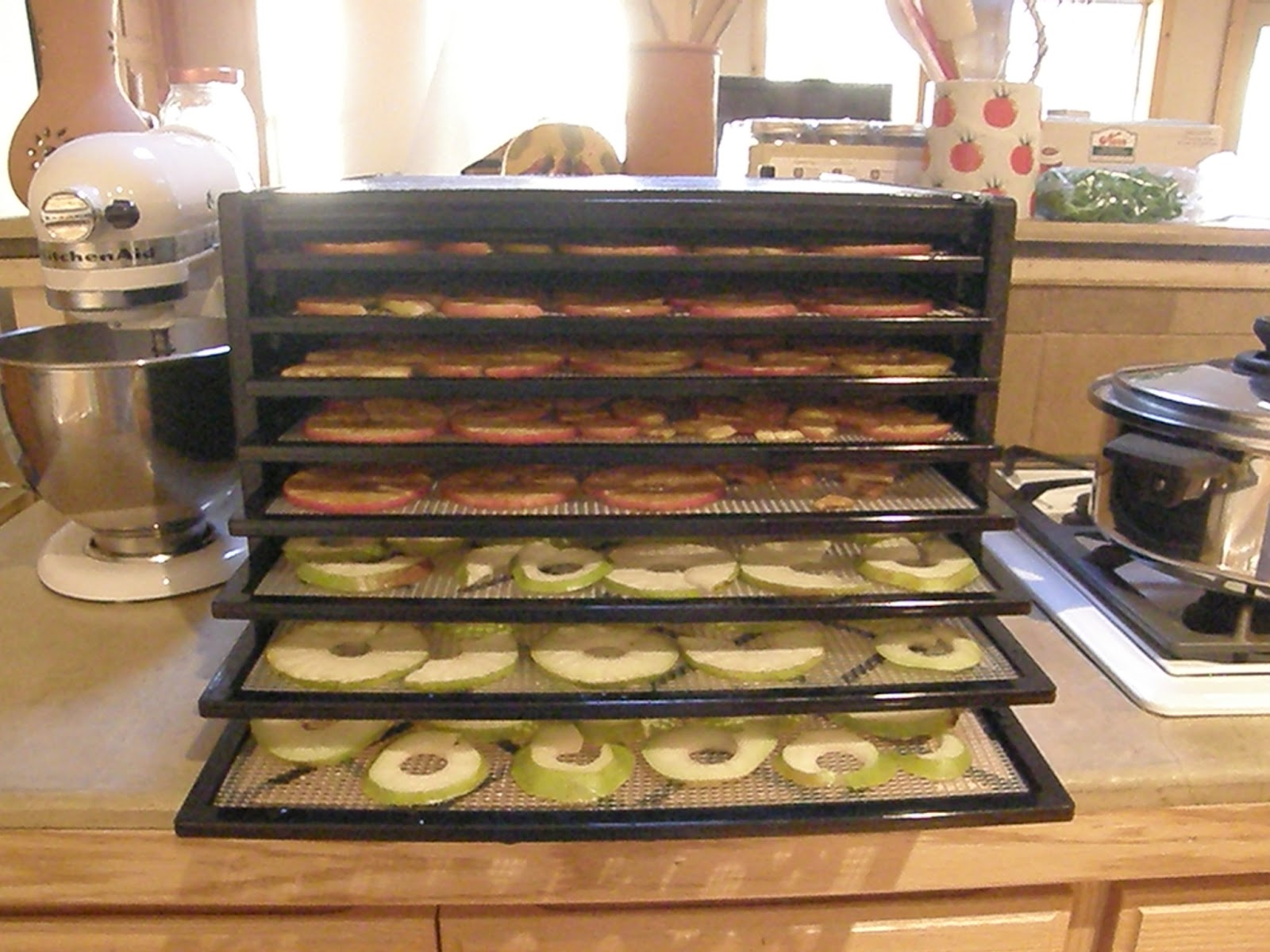
Excalibur 9 tray dehydrator
Instead, I'll be able to go over to my older daughter's mini-orchard and pick for free, which is what I should have done to begin with, but because I was working a temp job, the particular type of apples she had were past their prime before I had the time and energy to deal with them.   

So far I've canned 21 jars of apple butter, and dehydrated about 25 servings of apple and pear chips.  This week my older daughter and I will finish up by making and canning apple pie filling.  We were going to make some apple sauce, and still may, but think I think my daughter is more excited about the apple pie filling so we'll do that first and if there are any apples left over we'll make apple sauce. 

 
Update:  We made 9 quarts of apple pie filling:
 

Time For Preparedness

It's that time of year again.  Time for me to make sure I have everything  in place and ready in case we get snowed in for a few days, the electricity goes out for 2-3 days, The stream overflows it banks across the road, a wind, snow, or ice storm takes down trees across the road so we can't get out until they are cut through, or worse--a branch or tree takes down a power line across the road. All of these things have happened in the 7 years we've lived out here, 10 miles from town; some of them more than once and some years, two or three of these things happened in the same year.  For some reason, there is a conception that our area of WA state doesn't get any dangerous weather.  Some of the more notable Pacific Northwest events debunking that myth can be found at: http://www.climate.washington.edu/stormking/ .

Our deck, 12/26/08
Here in the foothills of Washington state's south-west Cascade Range temperate forest, we live in a "marine controlled environment" which basically means that our weather is mainly controlled by whatever weather is coming in off of the ocean. Usually, that means lots of precipitation, and mildish temperatures. The coldest I have ever seen it here is 19 degrees. But don't let that fool you, as you can see from the picture at left.  Anyone who's been here knows that the PNW is capable of precipitating 24/7 for days (weeks) on end. 

The picture to the left was during Christmas Break in 2008.  The only thing getting out of here was my Ford Expedition with all four tires cabled and my husband driving. He's very kinesthetically gifted, (its a beautiful thing to see him pull a wheelie on crotch-rocket and ride it for two blocks) but he did learn a thing or two about driving in the snow in Colorado to check oil wells daily for my Dad. The wells were usually located in the middle of a farmer's field with a poor excuse for an easement road.

But I digress.  Most of the people who live out here were stranded at home for almost a week during the 2008 snow event, and the people up above us were stranded for longer. They were asking if our neighbor could use his little Bobcat type tractor to plow the road (which is a actually a private drive) but his tractor couldn't make it down his driveway. 

We don't usually have nice fluffy, powdery snow here, its usually heavy and wet.  As a matter of fact I've heard it referred to by skiers as "Cascade Concrete".  It makes navigating the hills, corners, giant ditches and drop offs a bit more challenging than driving a straight line in powder conditions.  It also makes power outages due to power line poles being hit common in winter.  In "The Valley" (Vancouver town area) snow is a rare event so most people just stay home for a few days if it should happen to snow.  Up here in the hills is another story.  We usually get several good 6"+ snow events per year, and getting over a foot of snow is not unusual.

As exciting as the snow is, for the majority of the winter it is just warm enough to rain.  As a matter of fact, one of the worst scenarios I can think of (besides Fukushima completely melting down with the wind blowing this way) is a major earthquake during the rainy season.  There are several fault lines in the area. If we get a decent sized earthquake in winter when the ground is saturated, there will probably be multiple mud slides, many trees toppled plus structural damage to buildings.  There are usually a couple mudslides across major highways here every winter without earthquakes, so I can only imagine if there were one!   It could be a while before we could get to town, even if the earthquake itself wasn't that bad.  I'm going to assume that at least part of our house would still be standing should anything happen because Mr. F does everything to the extreme, so it's very well built.   

So, what are the biggies that we need every day if we can't get out? 
  • Food
  • Water
  • Shelter
  • First aid
  • Heat or Fire
  • Light
  • Tools and
  • Information (to build and fix things--hard copy books).  
  • Medical Prescriptions 
  • A few creature comforts are never amiss, I have shelves and shelves of books. 
  • Communication/Information (Ham radio? We have very little to no cell phone service here.)
Just because I happened to notice my kerosene lamps the other day, and because we have most of the other stuff taken care of, I'm going to start with "light".

If there is no electricity (which is likely because most of the power lines out here are above ground) we have a generator that can be direct connected into our electrical box thingy in the basement, so we'll have electricity that way, but we don't want to run the generator all the time, especially not at night. 

Here at latitude 45.6, on December 21, the shortest day of the year for 2012, we will have 8 hours, 42 minutes and 06 seconds of daylight.  That leaves us with about 15 hours of darkness. Add to that the fact that it is likely to be overcast and raining/snowing which seems to extend the darkness hours.  What are our options for light?

I have three cheap kerosene lamps, a few packs of emergency candles, and a large package of tea lights, an olive oil lamp (cheap and easy to make) and the random flashlight with a few extra batteries. 

Care and Keeping of Kerosene Lamps

Out of my assortment, the kerosene lamps put out the most light but also require the most care. Mr. F does have at least one propane lantern, but I don't have enough knowledge about it to say anything, so I'm leaving that alone for the moment. Right now I need to purchase some more lamp oil or kerosene (lamp oil burns cleaner) and wicks even though I didn't use up all I had for the last couple years.  The reason for this is that lamp oil and/or kerosene are only good to burn for light for about 2 years maximum.  After they have deteriorated, neither will soak through the wicks right, nor will they create much of a flame, but they will smoke--a lot. Just like leaving gas in your motorcycle over the winter and not doing all the winter prep leaves various parts gummed up. 

Clean out your lamp's fuel reservoir about once a year, with mild soap (dish soap) and water, rinse well and allow to dry completely before adding fuel. A lamp's fuel reservoir must be washed if/when switching back and forth between lamp oil and kerosene--the two should not be mixed.  After adding fresh fuel, submerge and soak a new wick in the fuel for at least one hour before attempting to use--the wick needs to be completely saturated with the fuel in order to burn correctly.  A longer soak will not hurt it.    After soaking, run the wick through the lamp's burner as usual.  I like to do this step every autumn, because I don't want to have to wait for an hour or more for a good light. 

I'm thinking about buying new burners for my lamps because a quality burner will make a difference in how much light a lamp can emit without smoking.  Parts for kerosene lamps and the olive oil lamp (below center) can be found at Lehmans (no association).

Safe Candle Holders

To make a quick and safe candle holder, fill a canning jar half way with dry beans, rice, lentils, peas, pebbles, marbles, fish tank gravel, sand, (or even dirt if you're in a real pinch) and stick an emergency candle in the center.  Make sure you use a canning jar because they have been tempered to handle the heat.  Don't use saved pickle jars, spaghetti sauce jars, etc. as they are more likely to break.  A tea light can be simply set in the bottom of a half pint canning jar and lit, or it can be bolstered by anything you can use to stand an emergency candle up in a jar. 

Used food grade metal cans are another cheap and quick candle holder, but be careful when touching because metal is an excellent heat conducter, whereas glass is a poor heat conductor (some call it an insulator).  Metal cans make better emergency heaters than lamps, but can double for both as long as caution is used. 

We'll explore homemade stoves in a future post.  What are your favorite alternative light sources?